
Gildeuretinol Acetate in Geographic Atrophy: What the SAGA Trial Reported
07/13/2026
Key Takeaways
- The prespecified primary endpoint was not met in the 24-month randomized comparison of gildeuretinol acetate and placebo.
- A prespecified 6-to-24-month analysis and several functional or patient-reported outcomes favored gildeuretinol, with nominal P values reported for those findings.
- The authors interpreted these exploratory signals as support for further evaluation in adequately powered trials.
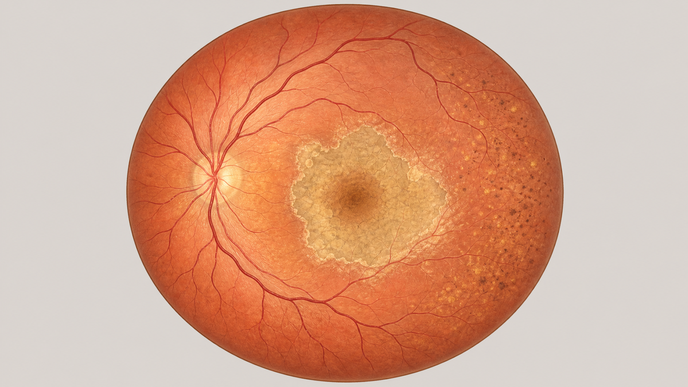
The prespecified primary endpoint was not met in the main 24-month analysis. Mean geographic atrophy growth rates were 1.62 mm2/year with gildeuretinol and 1.87 mm2/year with placebo, a reported 13.4% relative reduction. That corresponded to an LS mean difference of -0.25 mm2/year, with a 95% CI of -0.53 to 0.03 and P = 0.075. In a separate prespecified piecewise analysis from 6 to 24 months, rates were 1.61 versus 1.90 mm2/year. The LS mean difference in that interval was -0.29 mm2/year, with a 95% CI of -0.576 to -0.004 and nominal P = 0.047. The later interval favored gildeuretinol, but the main prespecified endpoint remained unmet.
At 24 months, LLVA declined by 3.9 letters with gildeuretinol and 8.3 letters with placebo, a 4.4-letter difference. The 95% CI for LLVA was 0.40 to 8.41, with a nominal P value of 0.031. BCVA declined by 6.9 versus 10.2 letters, yielding a 3.3-letter difference with a 95% CI of -0.63 to 7.23 and P = 0.099. Patient-reported outcomes moved in the same direction, as VFQ-25 scores declined 4.81 fewer points and Functional Reading Independence Index scores declined 0.35 fewer points with gildeuretinol. The corresponding 95% CIs were 0.87 to 8.76 and 0.11 to 0.58, with nominal P values of 0.017 and 0.004. Visual-function and patient-reported measures also favored gildeuretinol.
The authors interpreted these findings as exploratory support for further evaluation in adequately powered trials. Safety findings were not reported in the abstract. Across 24 months, the primary endpoint was negative, while later prespecified and secondary signals favored gildeuretinol.