Transcript
Announcer:
You’re listening to CE on ReachMD. This activity is provided by Evolve Medical Education and is part of our MinuteCE curriculum.
Prior to beginning the activity, please be sure to review the faculty and commercial support disclosure statements as well as the learning objectives.
Dr. Vajzovic:
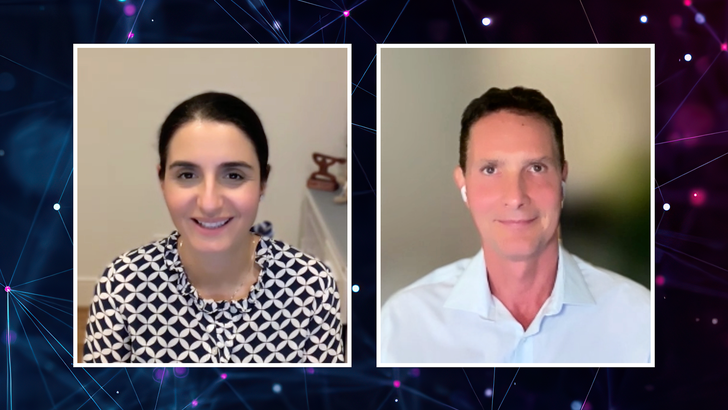
I'm Lejla Vajzovic. Here with me today, Szilárd Kiss. We're still on a quest for increasingly durable treatments for retinal disease. Szilárd, what agents are on the horizon that may help reduce the treatment burden associated with neovascular AMD?
Dr. Kiss:
The treatment for wet AMD has already taken shape. We have anti-VEGF antibodies that bind extracellular VEGF—the bevacizumabs, the ranibizumabs, and then port delivery system, which allows us to deliver ranibizumab over 6 months period. We also have soluble extracellular decoy receptors that bind VEGF-A, VEGF-B, and PIGF—most recently, the 8 mg of aflibercept that allows us to go out for 16 weeks.
Moving on to molecules that bind more than VEGF, the Ang-2/Tie pathway has really become something that has helped us extend that interval. Faricimab, of course, we have in our armamentarium. OLN-324 is in studies, as well as MK-8748.
Conjugated anti-VEGF therapies are also emerging, where there's an anti-VEGF with a polymer that allows sustained delivery over 6 months. Tyrosine kinase inhibitors allow us to suppress intracellular VEGF and PDGF using sustained delivery pathways that perhaps require as few as 2 injections per year.
And then, most recently, the Wnt activation pathway has taken shape, where it's a different mechanism outside of VEGF, outside of the Tie2/Ang-2. Now, all of those mechanisms really last for at most 6 months, at least in the clinical trials. When we think about sustained VEGF suppression in wet AMD, we think about something like gene therapy, where it may be a one-and-done for many patients.
And you think about going from episodic anti-VEGF injections, whether that's episodes every 12 weeks or every 6 months, to 1 injection with VEGF suppression for potentially years to come. There are 3 programs that are worth noting. There's the ixo-vec program; that's an intravitreal delivery of something akin to aflibercept.
There's the intravitreal delivery of the 4D-150 that uses the R100 capsid that also adds an RNAi. And then, finally, and perhaps the furthest along, is sura-vec, which uses something akin to ranibizumab, requires a surgical delivery with subretinal approach. All of these approaches really change why we think about how often we may need to treat our patients.
When we look at data from PDS and some of the anti-VEGF therapies, the sustained delivery, especially over long term with anti-VEGF, allows us perhaps to switch over that decrease in vision that comes from traditional therapies and maintain vision over 4, 6, 8 years plus.
Dr. Vajzovic:
Thank you, Szilárd, for this really outstanding overview of sustained delivery options for neovascular AMD. Some of those available to us currently with the durable agents, such as second-generation anti-VEGF options that we have to reduce the dosing intervals. We most certainly hope to have more options, but really potentially different modes of action, such as TKIs, which act as intracellular VEGF inhibition and potentially could be treated once or twice a year for neovascular AMD. We do have some other longer-duration options, such as port delivery system, the FDA-approved surgical drug delivery platform, with also very favorable long-term visual acuity results and predictable refills once to twice per year, which is quite favorable for patients as well. But, like you mentioned, it would be great to have longer, like a long-term duration and gene therapy, which is investigational at this stage, would most certainly be an option for potentially one-and-done approach for all our patients with a steroid prophylaxis for those utilizing the intravitreal approaches.
I think this was a really great discussion. Stay tuned for the next episode, where we'll look closer into gene therapies for treating neovascular AMD. Thanks for listening.
Announcer:
You have been listening to CE on ReachMD. This activity is provided by Evolve Medical Education and is part of our MinuteCE curriculum.
To receive your free CE credit, or to download this activity, go to ReachMD.com/CME. Thank you for listening.
 Evolve Medical Education LLC (Evolve) is accredited by the Accreditation Council for Continuing Medical Education (ACCME) to provide continuing medical education for physicians.

