Transcript
Announcer:
You’re listening to CE on ReachMD. This activity is provided by Evolve Medical Education and is part of our MinuteCE curriculum.
Prior to beginning the activity, please be sure to review the faculty and commercial support disclosure statements as well as the learning objectives.
Dr. Kiss:
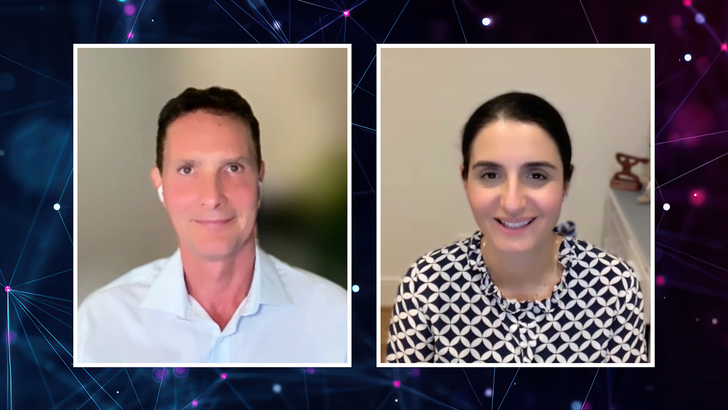
I'm Szilárd Kiss. Here with me today is Lejla Vajzovic. Lejla, new data on treatment of neovascular AMD with gene therapy are emerging. What are some of the key findings of these treatments?
Dr. Vajzovic:
Yeah. Thank you, Szilárd. It's fantastic to be investigating longer duration options and essentially creating little anti-VEGF biofactories by delivering gene therapy to the eye to really fight off or treat retinal diseases such as wet AMD. There are 3 really broad programs: ixo-vec, sura-vec, and 4D-150. We've heard a little bit more about these programs earlier, but ixo-vec starting with really encoding for aflibercept entity we are very known with. Intravitreal, so in-office approach, which will be great to have. Really well-known capsid. Sura-vec is the anti-VEGF Fab, ranibizumab-like, so it's really the longest program that's been out there with subretinal approach, being that long-term or longest study program, and then suprachoroidal for wet AMD and will be looked at DR as well. And what we know very well from these programs, we've had lots of learning points, and we'll share some of those. And then 4D-150 being one of the kind of newer gene therapies on the block have definitely benefited from learning from ixo-vec and sura-vec programs, which have been on the investigational, a little longer than 4D-150. And what 4D-150 offers a little differently is really aflibercept with VEGF-C RNAi. So really having additional plus what I would say for treatment of wet AMD and DME. Now, when we look at these programs across the board and just really review phase 2 trial, starting with ixo-vec LUNA phase 2 trial, mind you, again, this is a longer-term program and such.
When we started treating patients with gene therapy, we very much envisioned treating those high treatment burden neovascular AMD patients who routinely had received 10-plus injections prior to getting enrolled per year prior to getting enrolled in the trial. And this intravitreal approach offered 2 doses, the lower and higher dose, and really investigating to not only maintain vascular visual acuity and retinal thickness, but really decreasing the mean analyzed anti-VEGF treatment burden, and this was significantly lowered to 1 to 2 injections per year. The sura-vec program, the phase 1/2 trial, for wet AMD similarly very much enrolled very high treatment burden patients. This is a gene therapy subretinal approach, so meaning trip to the OR to deliver this therapy. Two doses being really studied. Actually, there were more, but we really pivoted to these 2 doses that proceeded to further the phase 3 trial. And similarly very high treatment burden dropping down to 2 to 3, maybe 4 injections per year. Again, very high treatment to decrease. The sura-vec is also being studied in suprachoroidal approach. I think that's promising because it's also in-office approach and lots of learnings being done in that program. And last, 4D-150, the phase 2b PRISM trial. Will note, unlike the other ones, the 4D-150 had a little bit of a time to learn or this program has learned from others, so they all—not only included previously treated patients, but newly diagnosed patients as well that were responsive to anti-VEGF and enrolled in intravitreal approach, similarly having higher treatment burden and decreasing it to almost 1 injection per year.
So as we kind of think about phase 3 trials, really the ones to note is Artemis and Aquarius, phase 3 for ixo-vec. Pretreatment with anti-VEGF followed really by monthly and then bimonthly injections. In terms of control, the sura-vec has a phase 3 ATMOSPHERE and ASCENT trial that has finished enrollment and reports will actually be due towards the end of this year and early next year. And 4FRONT-1 phase 3 study similarly has very much finished enrollment and reports will be due next year. So it's exciting to have really broad phase 3 programs for all of these.
Dr. Kiss:
Thank you, Lejla. It's exciting how quickly our field really has embraced the biofactory approach, getting away from the episodic injections and having something that can suppress the VEGF levels long term. You know, we look forward to the phase 3 data, which is forthcoming for all 3 programs.
Well, it certainly is an exciting time for gene therapy. Stay tuned for our next episode, where we take a closer look at the safety of these treatments. Thank you for listening.
Announcer:
You have been listening to CE on ReachMD. This activity is provided by Evolve Medical Education and is part of our MinuteCE curriculum.
To receive your free CE credit, or to download this activity, go to ReachMD.com/CME. Thank you for listening.
 Evolve Medical Education LLC (Evolve) is accredited by the Accreditation Council for Continuing Medical Education (ACCME) to provide continuing medical education for physicians.

